The Trap of the Liminal: Why We Get Stuck in Between

All the libations these last few months have been poured out to the thresholds of existence. We’ve covered liminal times, liminal spaces, liminal states, even the etymology of the word and the history of the field of study. Soon, I’ll be getting back to poets and novelists, mystics and philosophers, but first there’s something important we need to address about the liminal.
You may recall that liminal states occur when we become suspended at an existential or psychological threshold—between identities, roles, or ways of understanding the world. They may arise through the passages of a human life, be triggered by external events, or emerge from internal change—often, all three converging at once. There are some that are chosen, but usually we’re thrust into them. When that happens, there’s a common thread.
They. Are. Hard.
When you're in one, your old identity and sense of safety are gone and a new one hasn't yet arrived. That gap is filled with uncertainty, grief, disorientation, longing, helplessness, sadness, and sometimes real anger. But liminal states are powerful because they carry the seeds of transformation. The very deconstruction that feels so destabilizing in our lives is what makes room for something new. New beliefs. New identities. New ways of being in the world.
But a liminal state can also become a trap.
A liminal phase does not guarantee transition. It’s a powerful threshold where transformation becomes possible. But that same in-between that invites renewal can shift into something else entirely. Instead of passage, we can get stuck in suspension. Instead of change, we can drift into stagnation.
And sometimes we don't even realize it's happening.
This usually occurs when we resist the hard work of actually moving through the transition.
I've done this myself.
I suspect we all have.
Liminal states ask a lot of us. Honesty. Relinquishment. Decision. Acceptance. Change. Risk. All the hardest things in life! When we avoid those demands, the threshold stops feeling like a doorway and starts feeling like a waiting room we can’t quite bring ourselves to leave—or worse, one that’s closing in around us.

Why Do We Resist?
A few reasons. All of them understandable.
Fear of the Unknown
The familiar past, even when it was painful, can feel safer than the uncertainty of what comes next. We know how to survive what we already recognize; we don't know how we'll fare in unfamiliar territory. And growth inevitably asks something of us. Liminal seasons are disorienting by nature — often unpleasant, sometimes deeply painful, our very identity unclear or even shattered. With no clear direction and no guaranteed outcome, we may retreat into what already feels secure rather than risk stepping toward what has not yet taken shape.
Idealization
Nostalgia is a genuine ache for something real that is gone, but it becomes idealization when we polish the past into something purer and more golden than it ever was. The more uncertain or painful the present feels, the more tempting that imagined past can become. Once we rewrite the past this way, the idealized “before” becomes a standard the present can never meet, and we may find ourselves clinging to something that never quite existed—unable to fully inhabit the present or move forward into what comes next.
The Identity We’re Afraid to Lose
Sometimes what keeps us stuck in the liminal is an attachment to a version of ourselves the transition is asking us to release. Even painful identities become strangely precious: the one who was wronged, the one who survived, the one who sacrificed. When we confuse our wound with our identity, moving forward feels like self-betrayal. The invitation of the liminal isn’t to erase who we were or anything that happened to us. Rather, it is to assimilate our experiences and continue on the journey of our becoming.
Blame and the Power We Surrender
When we've been genuinely wronged, our wounds are real and our pain and anger legitimate. Letting go never happens overnight — and it's harder still when the person who hurt us cannot see or admit what they've done.
But there is a difference between holding someone accountable and handing them the key to our forward movement. By waiting for the apology, the acknowledgment, the remorse — sometimes from someone who will never offer it — we surrender our becoming to the person who hurt us. Releasing that hold isn't absolution. It's reclaiming our stories as our own.
Waiting for the Perfect Moment
Not all waiting is avoidance. When grief is still raw, when our wounds are fresh and our bodies and spirits simply trying to survive, we need to honor that. The soul has its own timeline, and that timeline deserves respect.
But there is another kind, and most of us know how it feels: when we tell ourselves we're not quite ready, even as a part of us senses that movement is possible — and we're choosing not to begin.
The question, asked gently and without judgment: Am I waiting because I genuinely cannot yet move? Or because moving would require something I'm not yet willing to give — or let go?
How Resistance Shows Up
The reasons above are the why. But resistance also has a how — a particular shape clothed in something ordinary, even admirable. Some of its most common forms:
· Overworking or compulsive productivity
· Numbing — scrolling, bingeing, dissociation
· Rage as armor
· Cynicism or detachment — irony and humor as armor
· Avoiding conversations or endlessly delaying decisions
· Perfectionism
· Caretaking or over-functioning for others
· Ignoring your feelings; the "I'm fine" performance
· Isolation
· Intellectualizing — researching, understanding it to death
· Repeating the same relationship dynamic over and over
· Spiritual bypassing — using faith language to sidestep the truth
· Self-medicating — alcohol, drugs, anything that dulls the edge
Recognition Is the First Step Toward the Door
Left unchecked, our resistance traps us in the liminal. We repeat old patterns because they are patterns we know—even when we understand on some level they're not life-giving. Then the liminal becomes less a passage into something new and more a circling of the same old ground.
The good news is that recognizing the trap is the first step toward the door.

If you’re feeling stuck in a liminal state, first let me say—I’m sorry. It’s not easy finding your way through and out. I know. Because I’ve been there. To read about some of the practices humans have found helpful throughout the ages, check out How to Navigate a Liminal State. And be sure to reach out to someone you trust—friends and family, a spiritual advisor or therapist.
This essay is part of The Liminal Hub and an excerpt from my 13-session course, Tell the Story of Your Soul, available online and in print.
Join my free newsletter
Posts come about twice a month to your inbox or Substack app — always free.
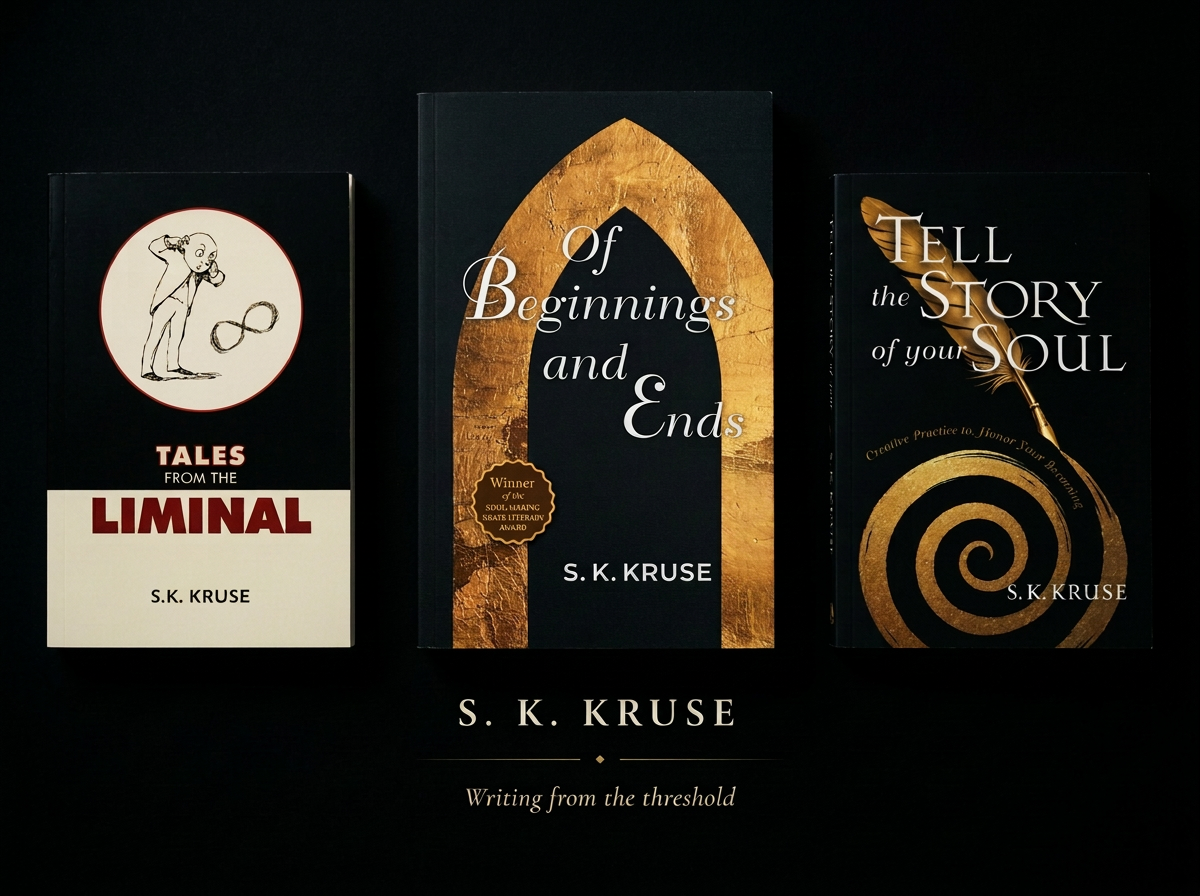
S. K. Kruse is the author of Tales From the Liminal, Of Beginnings and Ends, and Tell the Story of Your Soul. She is the co-curator of The Liminality Project and founder of The Liminal Essay Contest. She is available for workshops, discussions, and retreats. Find out more about S. K. Kruse’s books and projects here.