Press & Media — Of Beginnings and Ends
Everything you need for interviews, review copies, and event bookings. You can download entire press kit here, or scroll for copy and paste bits, as well as individual files from the press kit.
(If you’re looking for the press kit for Tell the Story of Your Soul, keep scrolling.)
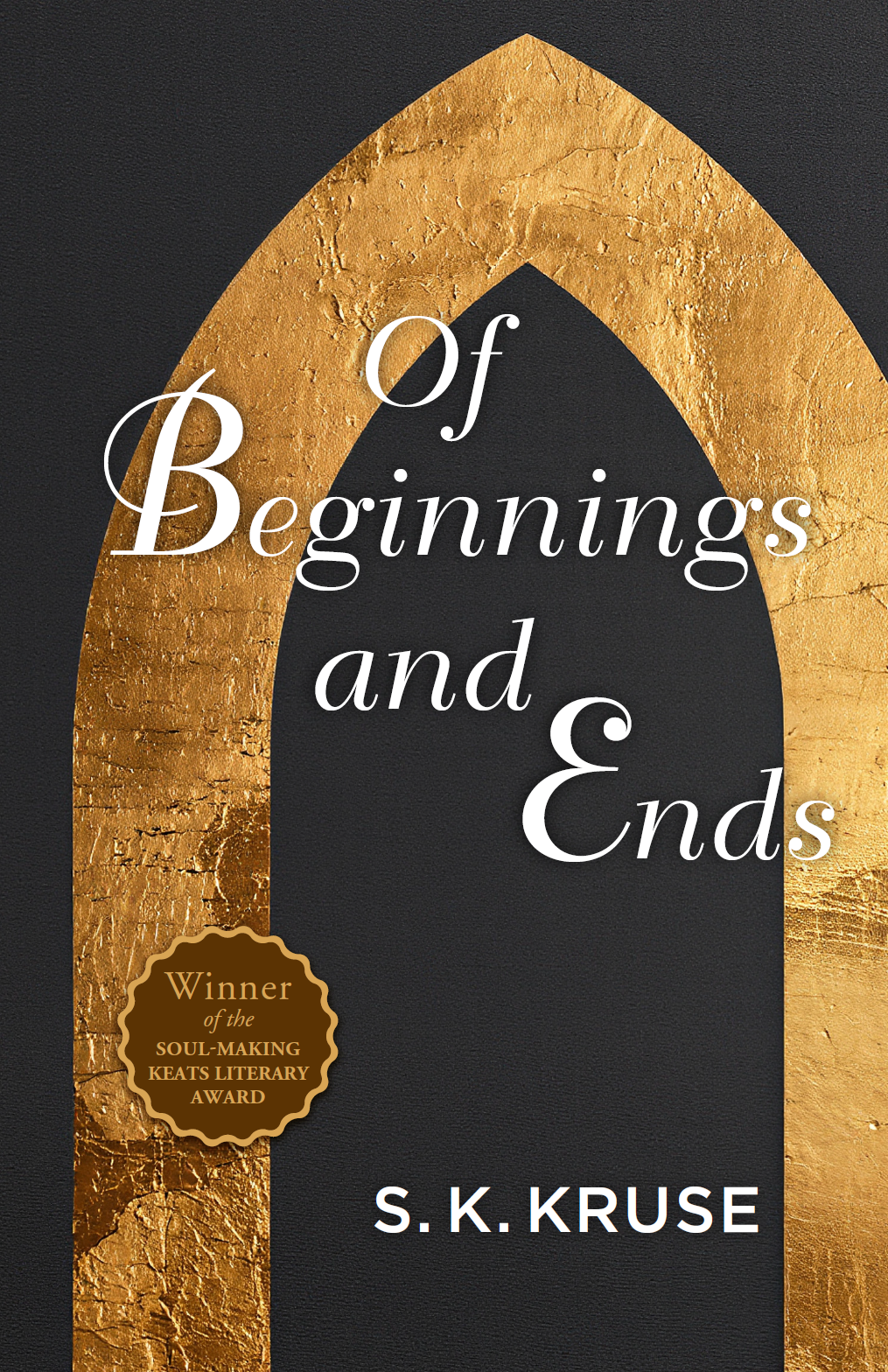
The Book
Of Beginnings and Ends · S. K. Kruse · Deuxmers · September 8, 2026
A Soul-Making Keats Literary Award–winning novel
Paperback ISBN 978-1-944521-26-4 · $14.95
Hardcover ISBN 978-1-944521-58-5 · $27
Ebook ISBN 978-1-944521-27-1 · $8.99
258 pages · Literary speculative fiction · For readers of Piranesi (Susanna Clarke) and Death Valley (Melissa Broder)
Available through Ingram or on consignment · Review copies available through the link above.
About the Book
In every ending waits a new beginning.
Evelyn has always been able to feel the hidden sorrow of others. One day, she reaches out to a stranger drowning in grief and is whisked away to the luminous Hall of Beginnings and Ends, which demands a choice. She must pass through a mist-shrouded arch to her best path forward, or a side door offering a detour. Either way, pain awaits—the crucible of transformation or the slow decay of refusing to change.
Across the years, Evelyn returns to the hall without warning, always met with the same demand. Choose. Each time, she is plunged into strange realms uncomfortably familiar, where her hopes and fears, beliefs and doubts take shape as uncanny landscapes and characters who seem to know her better than she knows herself.
Witty, numinous, and deeply human, Of Beginnings and Ends is a reckoning with the painful crossroads of existence, and an ode to the courage it takes to embrace every ending as the threshold of a new beginning.
Praise
Of Beginnings and Ends is the winner of a Soul-Making Keats Literary Award from the National League of American Pen Women.
"S. K. Kruse's thought-provoking and humorous portrait of Everywoman Evy and her soul-searching quest is a riveting philosophical, spiritual, and psychological saga that not many writers could have produced… It will appeal both to intellectual thinkers and everyday general interest readers." — D. Donovan, Senior Reviewer, Midwest Book Review
About the Author
One line: S. K. Kruse is the Soul-Making Keats Literary Award–winning author of Tales From the Liminal, Of Beginnings and Ends, and Tell the Story of Your Soul.
Short: S. K. Kruse is an author of speculative and mythic fiction whose work inhabits the intersection of philosophy, mysticism, and the uncanny. Her novel Of Beginnings and Ends (Deuxmers, 2026) received a Soul-Making Keats Literary Award from the National League of American Pen Women, and a story from Tales From the Liminal (Deuxmers, 2021) was longlisted for the John Steinbeck Award for Fiction. She is the creator of Tell the Story of Your Soul (Limen & Lumen, 2026), founder of Limen & Lumen and the annual Liminal Essay Contest, and co-curator of The Liminality Project. She writes from the Wisconsin Driftless, where she and her husband raised eleven children.
Long: S. K. Kruse is a fiction writer and co-curator of The Liminality Project. Her work explores the “betwixt-and-between” of human experience—the thresholds where one way of being has fallen away and what comes next has not yet fully emerged. She explores this terrain through short fiction, essays on The Liminal Hub, and through telography, a word she coined for “the story of a soul,” or an “account of one’s becoming.” On the page and beyond, her work keeps returning to this strange and fertile middle ground.
Her debut collection, Tales From the Liminal (Deuxmers, 2021), gathers fifteen short stories set within these threshold spaces. A Study Edition for classroom use followed in 2025. Her fiction has been longlisted for the John Steinbeck Award for Fiction, and her next book, Of Beginnings and Ends, is a Soul-Making Keats Literary Award–winning telography, forthcoming from Deuxmers on September 8, 2026.
At The Liminality Project, Kruse serves alongside Founding Curator Dr. Timothy Carson, who teaches courses on liminality in the Honors College at the University of Missouri. She is also a member of the Guild for Engaged Liminality, which co-sponsors the annual Liminal Essay Contest that Kruse founded for high school and college students to explore and write from the thresholds of their own lives. The fifth annual contest opens January 1, 2027.
For those who want to explore the story of their own becoming, Kruse created Tell the Story of Your Soul, a self-paced online course consisting of thirteen sessions across four modules. The course is free through October 20, 2026, with a print course and journal available for those who prefer to work on paper.
She also writes Libations from the Liminal, a newsletter from the borderlands, where philosophy, spirituality, and the arts are poured out as offerings to the mysteries of existence.
Background
A UW–Madison alumna and Wisconsin native, Kruse lives with her husband in the rolling hills of the Driftless region, where they raised eleven children. Her writing has been shaped by writers and thinkers ranging from Bradbury and Kafka to Tillich and Camus.
Speaking & Workshops
Kruse welcomes invitations to discuss her fiction or for presentations, workshops, retreats, and classroom visits exploring creativity, storytelling, and liminality through Tell the Story of Your Soul and Betwixt & Between: Discovering the Gift of the Liminal.
Suggested Interview Questions
You call this book a "telography" — a word you invented. What is a telography, and why did the story of a soul need its own word?
Soul stories run deep in our human history. Across centuries and cultures, people have felt the pull to look inward, gather what they find, and give their soul’s journey some kind of shape. It’s such a rich genre, but we had no name for it. Augustine's Confessions. Bunyan's Pilgrim's Progress. Gilbert's Eat, Pray, Love. And that’s just naming a few. (Find more here.)
Because I like words, I, of course, had to make up one for this unique genre. I call them “telographies”—a mashup of the Greek words telos (end or fulfillment) and graphia (writing).
What I love about the idea of a telos — your deepest purpose, or that for which you exist — is that you don't have to have any particular philosophical or theological framework to see that everything that exists has its own inherent purpose, simply by existing in the particular way it exists.
We all make this inner journey, whatever our worldview, whatever our choices. We all grow and change, get stuck and lose our way, then hopefully find the thread again, moving forward through lessons hard learned. A telography is simply a story of becoming.
Where did the Hall of Beginnings and Ends come from?
A dream. Or at least the hypnopompic state right before waking up, where a lot of my ideas emerge. I’ve read a lot of telographies throughout my life, so in that wonderful way our conscious and unconscious mind work together, it became this place of existential choice.
Evelyn can feel the sorrow hiding in other people. Is that gift a blessing or an affliction — and which was it for you as the writer?
It’s a gift and a burden to be an empath in a world full of pain and need. It helps you love and accept people where they are at, care for them in their hour of need, but it can be difficult to discern boundaries and hard to tend to your own needs, as you feel other people’s needs and sorrows as though they were your own—sometimes it’s even difficult to tell them apart.
This is how it is for me, too. In fact, I drew on my own interior experiences to create this fictional work.
Reviewers have singled out the humor — comic relief at unexpected moments in a book about grief and transformation. Why was the humor essential?
It’s how the book came out of me. It felt like it had to be told that way. I suppose it was my voice—or a voice, at least. In the preface I say, “You could have written Of Beginnings and Ends. In fact, anyone could have. Because it’s the story of a soul and everyone has one.” I believe that’s true. But we would each have a unique journey through the Hall of Beginnings and Ends, and a unique way of telling it.
The novel moves through faith, doubt, and what survives them. Who did you write it for?
I wrote it, I suppose, to process my own experiences, but also to share them with others going through similar things. I write a lot about the liminal—in particular, liminal states—those threshold experiences in life, where one thing has ended and the new has not yet begun, where one worldview is slipping away but another hasn’t yet taken its place. They’re such disorienenting, destabilizing times—I think by sharing our experiences, we can help each other get through them.
The Hall always offers two doors — the arch and the side door. Why is the detour as important to the story as the transformation?
Because we spend so much of our lives taking detours! It’s really hard to change. It’s really hard to accept change. And we have a million strategies to avoid it. Sometimes it takes us so long just to recognize the strategies we’re using to avoid the pain of change, that, well, at least in my experience, acceptance can be a decade in the making. But it’s all part of the journey. As hard as the liminal passages of our life are, since incorporating the difficult parts of my story and even the years I spent avoiding something I needed to accept, I have been able to embrace them as part of my becoming.
Writing this novel led you to create Tell the Story of Your Soul, a guided course for readers to trace the liminal passages of their own journey. How does a novel produce a practice?
To write Of Beginnings and Ends, I broke down the turns in my own journey, exploring them in their pre-liminal, liminal, and post-liminal phases, then crafted them into a soul-journey narrative for Evelyn in the Hall of Beginnings and Ends. I found the experience to be so filled with insight, catharsis, and healing that I wanted others to experience the same.
Excerpt
The opening of the novel, "Beginnings," is available as a PDF below.
Beginnings
When Evy was small she thought she was the center of it all. Faces flitted in and out of view like planets around their little sun. Mother. Father. Neighbor. Friend. The milkman with his clinking bottles. The mailman with his bag. Apart from her, their lives were naught.
Outside her home, it held true too. The German shepherd growling in the alley existed only as a terrifying obstacle to a friend’s house, and the preschool teacher reading stories to children fanned out around her feet existed only in the little schoolhouse a few blocks down the street.
At some point in those earliest years Evy became aware of her self, that little star burning bright at the center of things. Walking in a pretty dress into the living room she thought to herself, I am walking in this pretty dress. Talking to her friend about a bird’s nest they found, she thought to herself, I am talking to my friend about this bird’s nest.
This self-realization only further established her position, firmly fixed her already shining place in the heavens, and Evy continued on about her days playing in her neighborhood and living in her house, where the refrigerator held the food she ate and the bookshelves held the books she read, and her mother kissed her forehead and made her cookies as she orbited around Evy, the little sun.
One late summer afternoon, when Evy was seven, she looked out across the parking lot of the city pool while unlocking her bike after a day of swimming. Her warm, wet bathing suit clung uncomfortably beneath her sundress and the smell of chlorine emanated from her skin, as her gaze fell upon the sweat-soaked back of a woman digging for something in the middle seat of a rusted, purple van.
Behind Evy the squeals of children splashing in the water rose and fell. Waves of heat rippled off the pavement, stretching the white-blue sky to the point of bursting, but her attention zeroed in past the long row of station wagons and boxy sedans to the middle seat of that van.
Evy tilted her head to the side and squinted as a new thought blossomed gently in her mind: this woman was looking in her purse, viewing things through her eyes and feeling them in her hands—the weighty metal of a set of keys, the smooth plastic of a sunscreen bottle, the pinching hinge of her sunglasses. She might be tired or frustrated or eager to get inside. She might be early. She might be late. She might be exactly on time, but she was there in that parking lot, picking up her kids from that pool—and from that woman’s vantage point, all the people around her, including Evy, were just little planets in a world that revolved around her.
Evy looked up then, mouth parted, eyes darting inside her motionless head as she took in her surroundings through this new lens. A skinny boy jumped off a nearby park bench. A wrinkled woman walked her poodle. Two shirtless teenage boys tore out of the parking lot in a pickup truck blasting KISS.
All of them suns in their own worlds.
All their worlds overlapping.
A Copernican revolution of the mind—but at the age of seven, Evy didn’t know what to do with it. She just stood there next to her banana seat bike, in awe of the revelation on that cracked patch of asphalt outside the city pool.
Half a minute later her stomach rumbled its post-swimming growl, and she hopped on her bike and rode for home, fixated on the Hostess CupCakes stashed in her closet, forgetting, until she lay fed and exhausted on her bed that night, about the billions of other suns floating around on planet Earth.
As with all revolutions, consequences followed.
The curious insight that day at the pool merged with an empathetic nature further sensitized when a black hole passed near enough her celestial position to yank a body of great significance out from orbit around the little sun and fling it far into the recesses of the universe.
The smiling face that read her stories and bandaged her knees was, one day, no longer there.
The priest said the Lord took her, but her father said it was cancer.
Either way, her mother was gone.
Evy made no explicit connection between any of this—she was only in the second grade—but, nevertheless, it began to affect her.
In elementary school, Evy would be playing bionic woman at recess and notice the girl with the greasy hair and uneven gait standing alone and staring out through her coke-bottle glasses at the other children laughing and playing, and Evy would be stopped in her secret agent tracks by a terrible sadness.
In middle school, she would be racing to finish her conjugation worksheet before her academic nemesis finished hers but then catch a glimpse of the boy who drew amazing insect monsters and who would cry at least once a week, burying his face in his hands—and the terrible sadness would take hold of her. Evy’s rival would run her paper up to Sister Mary Therese, but Evy would remain at her desk, rapt and trembling, feeling the boy’s agony as he packed up his things for the day, feeling his shame and confusion as he walked down the long, dark corridor in dread of yet another phone call home.
Then there was the summer before her junior year.
On a sweltering evening at the county fair, while making out with her boyfriend behind the grandstand as Cheap Trick crooned to half-filled bleachers, she caught sight of a carnival worker at the distant, grassy edge of the fairgrounds, sitting alone on a stool behind his trailer, staring down at the ground. She didn’t even notice when the blond, bronzed boy slipped his hand up under her shirt because the terrible sadness fell like a pall over the fairgrounds and all she could think about was what the man behind the trailer was thinking.
His mother?
His brother?
A girl he once loved?
The circumstances that led to him sitting there on that stool behind that trailer at that county fair filled with beefy farm kids and mulleted teenagers?
After that, barely a day went by that she didn’t see the terrible sadness lurking somewhere, dogging some unfortunate soul—and it all culminated one late spring evening about a month before her high school graduation.
Evy was sitting at a table on the first floor of the public library, chewing an eraser and listening to Pink Floyd on her Walkman. She’d been there for several hours already, studying for a history exam with her best friend Theobald, but they’d spent the whole time sneaking Pop Rocks and arguing in impassioned whispers about the existence of God and the meaning of various lyrics on The Wall.
Theo was gone now but Troy, who had just finished a parent-mandated tutoring session, was throwing notes at her from the table behind, and she kept replying because, well, she was single and it was fun to flirt with a guy who looked like Matt Dillon—even if she had a ton of work to do and the rest of the week was packed with two shifts at the corner market, a tennis meet, a choir concert, and a newspaper layout deadline. Maybe she should have stayed home to study—it would have been less distracting. But certain types of quiet were distracting, too, and much less pleasant than philosophical banter with your best friend or flirty exchanges with the high school hottie.
Another note flicked against the back of her head. Evy picked it up and smoothed it out on the table. “CREEK?” it asked in perfect block letters, followed by a winky face. Evy smiled, eyebrows raised. Troy always carried a blanket and a six-pack in the trunk of his muscle car, and she knew from other girls in her class how an evening at the creek with him usually ended up.
An attractive offer—but as a young woman coming of age in the late eighties, her twelve years of Catholic education all seemed to boil down to the single, searing commandment: Thou shalt not have premarital sex. And so Evy—in fellowship with all the martyrs and saints who had gone before her—scrawled “MUST STUDY!!!” She drew a smiley face on the note and tossed it over her shoulder onto Troy’s table.
He left shortly after, winking as he passed. Evy looked down at her work with a satisfied smile. It was always nice to know someone like Troy wanted you even if you’d never meet up with him at the creek. She opened Crime and Punishment to reread the last few pages of the epilogue, then reviewed the last paragraph she had written.
At last ready to dive in, Evy glanced up at the clock to see how many minutes she had left before the librarian kicked her and the other stragglers out. But as her eyes made that small adjustment back down to her thesis, she caught sight of a middle-aged Korean man slouching at the last table between the A-frame of pulp fiction and the revolving rack of books on tape.
A ballpoint pen poked up out of the front pocket of his faded, beige button-up shirt, and worn khakis ended at scuffed brown shoes in the shadows beneath the table. A crop of short black hair retreated from a high, smooth forehead, and the bridge of his nose wrinkled between squinting brown eyes as his thin lips pressed together in thought. But these details faded away as the preoccupation inhabiting his countenance took the foreground, throwing into relief an unnamed sorrow that laid squatter's claim deep in the lines of his weary face.
Evy braced herself.
She looked down at her notes, a scribbled mass of hieroglyphs in the margins. She tried to read but could only see the giant “X” she had made through the second half of the page. She needed to study, but it didn’t matter. She was trying to make valedictorian, but it was of no account. She had frittered away two hours of library time and now only forty-five minutes remained—but it came anyway. Like an asteroid hurtling through the blackness, obliterating everything in its way, the terrible sadness slammed her from her perch in the heavens into orbit around the slouching man’s sun.
Evy gripped the table edge, her fingers numb, her jaw clenched as the man’s eyes glazed. But her efforts were futile. The tsunami of his grief and regret came crashing in on her. She looked away. Tried to think of Pop Rocks and Pink Floyd and muscle cars and creek banks, but the terrible sadness rushed around her and pushed up past her knees. It lapped at the tabletop, then surged over it, consuming her notes. It rose steadily, pressing against her chest, making it hard to breathe.
Soon she would be unable to breathe at all.
Evy looked toward the slouching man, but he was gone. Even so, his sorrow rose unabated. It pressed upward past her chin. She lifted her face and strained on her toes, gulping panicked breaths above the froth.
Her eyes, just inches above the raging whirlpool, darted in all directions. She craned her neck, searching for the man as it swelled above her lips, swallowed up her nose and eyes, pushing upward until she was submerged. Her gently sprayed spikes of hair held out a moment, then gave way as well, swishing resignedly above her in the flood.
There—on the third-floor rotunda where the state blue books and microfiche collected dust, the image of the man in beige rippled. He leaned forward over the balustrade.
But what was he doing up there?
With his glassy look and that unnamed sorrow deep in the lines of his face?
Was he about to do something… final?
She should go to him… but she couldn’t.
She didn’t know him.
It was none of her business.
He might yell at her.
Other people might hear.
She had deadlines to meet.
Responsibilities to tend to.
A father who needed her.
A curfew that soon expired.
The fountains of the abyss burst forth, and the flood gates of the firmament opened wide.
He might be crazy.
She shouldn’t talk to strangers.
There were professionals who dealt with this kind of thing.
Medications to take the edge off.
But she was there. Now.
How hard was it to push back her chair and stand up? To lift her foot and step. To walk across the room. Ascend the stairs. Extend a simple word. In case… just in case… he was about to succumb.
Then she was pushing back her chair and rising. A great sucking noise ripped through the rolling depths like someone had pulled the plug from a giant tub. The terrible sadness whirled and began to drain. Evy lifted her face above the whirlpool. She pushed her left foot forward, then her right, propelling her way through his sorrow. Soon she was wading, then slogging across the soggy carpeting, ascending the stairs.
The man leaned forward heavily. His hands spread wide on the balustrade, his regret and heartache unbearable weights hanging round his neck.
Just a few yards more.
What was that in his hand pressed against the rail?
A book?
Yes.
She could start there.
Just ask him about the book.
A simple question and a smile.
A way to begin.
Her fingertips fluttered across the pocked old lacquer of the balustrade, tingling as she neared. Even just the thought of the words spilling from her lips brought the rushing promise of respite.
The man turned his face toward her, his eyes registering confusion and then a spark of something that encouraged her a step closer. Evy stopped a bit before him, rested her trembling hand on the balustrade, and opened her mouth to speak.
Downloads
Permissions
The materials on this page — cover images, author photo, jacket copy, bios, quoted praise, and book excerpts — are provided to media, booksellers, librarians, and book clubs. They may be reproduced, in whole or in part, in a review, feature, interview, blog post, newsletter, or reading-group guide about the books, provided nothing is altered and full credit is given to the title, author, and publisher. Any other use — including reproduction in an anthology or other collection, use in audio, video, or AI training, or any commercial or for-sale use — requires prior written permission. Please write to info@skkruse.com; permission is usually quick and gladly given.
Of Beginnings and Ends copyright © 2026 by S. K. Kruse, published by Deuxmers. All rights reserved.
Contact & Links
S. K. Kruse · skkruse.com/speaking · linktr.ee/skkruseauthor · Instagram @skkruseauthor · Substack: Libations From the Liminal· The Liminality Project
Press & Media —Tell the Story of Your Soul
Everything you need for interviews, review copies, and event bookings.
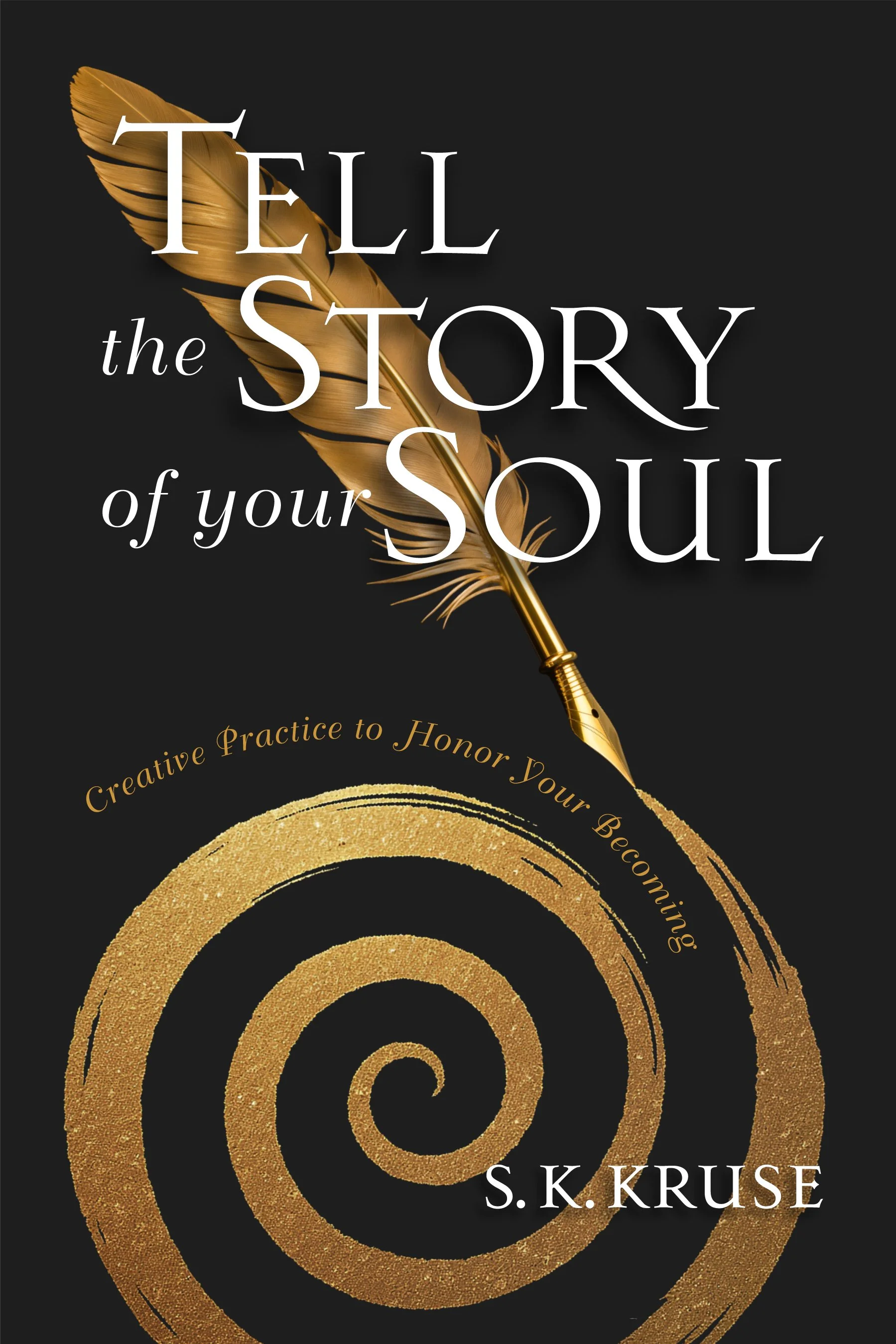
The Course — In Print
Tell the Story of Your Soul · S. K. Kruse · Limen & Lumen · August 18, 2026
Creative Practice to Honor Your Becoming
Softcover ISBN 979-8-9957182-0-8 · $29.99 Self-paced online course · $29.99 (lifetime access) Facilitator Kit for groups · $49.99
283 pages · 6 × 9 in · Body, Mind & Spirit / Inspiration · Religion / Spiritual Growth · Self-Help / Journal Writing
A 13-session guided course and journal in one.
Also available as an online course at TellTheStoryOfYourSoul.com
Special launch pricing through October 20:
Print course & journal — $10.99 (reg. $29.99)
Self-paced online course — free, with lifetime access (reg. $29.99)
Facilitator Kit for groups — free on request (reg. $49.99)
About the Course
A guided course and journal in one, inviting people of all spiritual traditions—and none—to give creative shape to their inner journey.
Through gentle prompts, participants trace the "turns" in their journey — the liminal seasons where something old was falling away and something new was trying to emerge — then give what they find a shape of their own. Words optional.
At its heart is a concept S. K. Kruse calls the telography — from the Greek telos (end or fulfillment) and graphia (writing) — a story of the soul's becoming. The practice grew directly out of writing her novel Of Beginnings and Ends, and draws on a long lineage of soul stories, from Augustine's Confessions to Bunyan's Pilgrim's Progress to Coelho's The Alchemist. It is created for individuals and groups of any spiritual tradition — or none.
"This is not a course about getting your life right or polishing it into a tidy narrative. You will not be asked to arrive at some verdict about who you are. You will not be asked to judge yourself or justify your choices. You will simply tell the story of your soul to honor your own becoming."
The Four Modules · Thirteen Sessions
I. Introduction — An overview of soul stories, the genre, and the process.
1. Preparing to Tell Your Story
2. What Is the Story of a Soul?
3. Why Tell the Story of Your Soul
II. Role of the Liminal — Understanding the phases of liminal passages and common responses to them.
4. What Is the Liminal?
5. Navigating the Liminal State
6. The Trap of the Liminal
III. Soul Discovery — The deep work: tracing the movements of your own inner journey.
7. Finding the Turns in Your Journey
8. Identifying Your Response to the Turns
IV. Story Crafting — Shaping what emerges into a creative form.
9. Telling Your Story From Your Soul
10. Choosing a Container for Your Story
11. Mapping Your Metaphor
12. Crafting the Turns in Your Story
13. Continuing the Journey
Each Turn, Three Movements
Pre-liminal — The life before: what you were, what you held, what began to loosen.
Liminal — The threshold itself, where the old is gone and the new has not yet arrived.
Post-liminal — The life after: what you became, what you kept, what you left.
Practical Details
Two available formats. Choice of self-paced online course or print course & journal. Identical sessions in both formats. Fill in the reflection sheets on your device or by hand in the journal.
Time required. Eleven sessions include a 30–45 minute reflection sheet. Two are worked turn by turn: 45–60 minutes per turn, over several sittings. No rush to finish.
Individuals or groups. Suited to solo practice or a shared journey. A Facilitator Kit covers groups, workshops, and retreats. Every participant needs their own account or journal.
Private by design. Journal is private by nature. HTML reflection sheets are stored on the participant's own device — never shared, never seen by anyone else. Facilitator materials never require personal sharing in group.
A creative and reflective guide, not a therapeutic program. For people from all spiritual traditions or none.
Advance Praise
"Astute observers of worldwide religion and culture have always noted the central role that liminality plays in spiritual formation… That recognition, however, has not always resulted in a concrete approach, method or framework. Until now, that is. Tell the Story of Your Soul is just such a resource. S. K. Kruse created this resource with individuals and groups from all spiritual traditions—or no tradition—in mind. I look forward to using this thoughtful and practical guide in my own scope of work."
—Timothy Carson, D.Min. — Author of Liminal Reality and Transformational Power and co-author of Crossing Thresholds:
A Practical Theology of Liminality; Professor of Liminal Studies, Honors College, University of Missouri.
About the Author
One line
S. K. Kruse is the Soul-Making Keats Literary Award–winning author of Tales From the Liminal, Of Beginnings and Ends, and Tell the Story of Your Soul.
Short
S. K. Kruse is an author of speculative and mythic fiction whose work inhabits the intersection of philosophy, mysticism, and the uncanny. Her novel Of Beginnings and Ends (Deuxmers, 2026) received a Soul-Making Keats Literary Award from the National League of American Pen Women, and a story from Tales From the Liminal (Deuxmers, 2021) was longlisted for the John Steinbeck Award for Fiction. She is the creator of Tell the Story of Your Soul (Limen & Lumen, 2026), founder of Limen & Lumen and the annual Liminal Essay Contest, and co-curator of The Liminality Project. She writes from the Wisconsin Driftless, where she and her husband raised eleven children.
Long
S. K. Kruse is a fiction writer and Co-Curator of The Liminality Project. Her work explores the “betwixt-and-between” of human experience—the thresholds where one way of being has fallen away and what comes next has not yet fully emerged. She explores this terrain through short fiction, essays on The Liminal Hub, and through telography, a word she coined for “the story of a soul,” or an “account of one’s becoming.” On the page and beyond, her work keeps returning to this strange and fertile middle ground.
Her debut collection, Tales From the Liminal (Deuxmers, 2021), gathers fifteen short stories set within these threshold spaces. A Study Edition for classroom use followed in 2025. Her fiction has been longlisted for the John Steinbeck Award for Fiction, and her next book, Of Beginnings and Ends, is a Soul-Making Keats Literary Award–winning telography, forthcoming from Deuxmers on September 8, 2026.
At The Liminality Project, Kruse serves alongside Founding Curator Dr. Timothy Carson, who teaches courses on liminality in the Honors College at the University of Missouri. She is also a member of the Guild for Engaged Liminality, which co-sponsors the annual Liminal Essay Contest that Kruse founded for high school and college students to explore and write from the thresholds of their own lives. The fifth annual contest opens January 1, 2027.
For those who want to explore the story of their own becoming, Kruse created Tell the Story of Your Soul, a self-paced online course consisting of thirteen sessions across four modules. The course is free through October 20, 2026, with a print course and journal available for those who prefer to work on paper.
She also writes Libations from the Liminal, a newsletter from the borderlands, where philosophy, spirituality, and the arts are poured out as offerings to the mysteries of existence.
Background
A UW–Madison alumna and Wisconsin native, Kruse lives with her husband in the rolling hills of the Driftless region, where they raised eleven children. Her writing has been shaped by writers and thinkers ranging from Bradbury and Kafka to Tillich and Camus.
Speaking & Workshops
Kruse welcomes invitations to discuss her fiction or for presentations, workshops, retreats, and classroom visits exploring creativity, storytelling, and liminality through Tell the Story of Your Soul and Betwixt & Between: Discovering the Gift of the Liminal.
Suggested Interview Questions
What is a “telography” — and why did the story of a soul need its own word?
Soul stories run deep in our human history. Augustine’s Confessions. Bunyan’s Pilgrim’s Progress. Gilbert’s Eat, Pray, Love. Across centuries and cultures, people have felt the pull to look inward, gather what they find, and give their soul’s journey some kind of shape. As far as I could tell, that impulse had never been named, and so, because I like words, I made one up for it: telography, a mashup of the Greek telos (end or fulfillment) and graphia (writing). What I love about the idea of a telos — your deepest purpose, or that for which you exist — is that it asks nothing of your beliefs. You don’t need a particular philosophy or theology to see that everything has its own inherent purpose simply by existing in the particular way it exists. Simply put, your telography is the story of your becoming. And you’re the only one who can tell it.
The course grew out of writing your novel. What happened in that process that made you want others to experience it? How have you made that process accessible to others?
To build the fictional world in Of Beginnings and Ends, I drew on the key turning points of my own inner journey. The process was filled with so much insight, catharsis, and genuine healing that it got me thinking everyone should get to do this. I tried to break the process down into concrete steps and make it gentle enough that those who go on this journey feel seen and understood as they navigate painful past experiences.
What is “the liminal,” and why is it at the heart of this practice?
A century ago, Arnold van Gennep first gave us the word liminal in his work on the rites of passage. Victor Turner later called it the betwixt and between. It is the threshold itself, where the old self has gone and the new one has not yet arrived. That is the most disorienting stretch of any passage, and it is also where the change actually happens, which is why the whole practice is built on it. Each turn is explored in three movements: pre-liminal, the life before and what began to loosen; liminal, the neither-here-nor-there; and post-liminal, the return — who crossed over, and what they carried back. One thing I wish I had understood much earlier in my own journey: the liminal isn’t only a place of possibility. It can also become a place we get stuck.
You say the medium can be anything — words optional. Why was it important not to make this only about writing?
Most of the telographies I'm familiar with are written accounts — either allegorical or autobiographical in nature. As a writer, my telography follows in this tradition. But I felt strongly about widening the scope. You can tell the story of your soul any way you want — painting, gardening, quilting, sculpture, music, dance, even flowcharts! However your soul wants to express itself.
The course is designed for people from all spiritual traditions, or none. How does that work in practice?
Whatever you mean when you say soul — spirit, self, the deep-down you — that is the subject of a telography. The framework is liminality, which describes human experience rather than prescribing belief, so the prompts ask what happened and what it meant for your becoming. They never ask what you should believe about it. Telography is not dogmatic, though it is unashamedly soulful, and people of every tradition and of none have written one.
“Let your soul speak” is a refrain throughout the course. What does that ask of us?
We all carry around accounts of ourselves and the world that were handed to us by other people, and it takes some quieting of the mind and heart to hear what is underneath them all. It also means telling your story for yourself first, free from the pressure of observing eyes, so that you can tell it in freedom and truth. Whether you ever share it with anyone else is entirely up to you. In the course, you will never be asked to arrive at a verdict about who you are, or judge yourself, or justify your choices. You are only asked to let your soul be your guide. And prepare to be surprised.
What changes when people make this journey together, in a group or on retreat?
I think different people need different things. Some will definitely prefer doing the course on their own. Others will appreciate being able to meet up with a group, even if the soul discovery portion is done in private reflection. There’s strength in safe, loving communities, and practically speaking, life is full — groups keep people moving through material they might otherwise set aside for a while. Either way, the reflection work itself stays private — everyone needs their own account or journal, and the facilitator guide never asks anyone to share what they wrote.
Is a telography a memoir?
It’s a cousin. A memoir remembers; a telography discerns. Where a memoir asks what happened?, a telography asks what was I becoming? It selects only the meaningful turns and reads them through the liminal arc — pre-liminal, liminal, post-liminal — listening for the purpose threading them together. A memoir is also usually written to be read by other people. A telography is written for yourself first, and whether it ever goes any further is entirely up to you.
How does the course sit alongside Of Beginnings and Ends?
Evy’s journey through the Hall of Beginnings and Ends isn’t mine event for event, but every inner turn in her journey came out of a turn in my own journey. This story is the result of me going through the process I invite others to go through in Tell the Story of Your Soul. The novel is one particular telography, and the course is an invitation to create your own.
Excerpt — "Why Tell the Story of Your Soul?"
From Module I, Session 3. Format condensed for this excerpt.
Story is powerful. And that power runs in more than one direction.
When we bring centered, compassionate attention to the story of our becoming, something remarkable becomes possible. We begin making peace with our past — sometimes even moving out of age-old ruts.
But revisiting the past can sometimes pull us into rumination rather than reflection — rehearsing grievances, reopening wounds before they are ready, or hardening a single narrative into something we mistake for the whole truth. We all carry stories about ourselves and the world that have become fixed in our minds, making it difficult to hear anything else — even from ourselves.
That is why you'll want to move through these sessions with intention and openness to what is surfacing. You'll hear this refrain throughout the course — let your soul speak — because that is what you're here to do. The following are some of the gifts that can emerge from the process.
Assimilation of Our Experiences
Assimilation is the process by which our experiences stop being things that "happened to us" and become part of the story of our becoming — and with this assimilation comes peace.
Some of us are experts at shoving down our feelings to pretend or even convince ourselves that everything is fine — that things didn't hurt or don't still hurt — but that is not the real peace that comes from witnessing and accepting our experiences as the path of our becoming.
In my own experience, assimilation and the peace that comes in its wake happen in deepening cycles over time. Almost as if my soul knows I can only handle so much at once—maybe, also, can only see so much at once. We all have our blind spots, after all—erroneous assumptions and beliefs about ourselves and the world. For me, it usually isn't until life comes barreling along, knocking me down, that I discover one of them in the ruins. Whether these life experiences are primarily external or internal — usually some combination of both — the process of assimilation seems to require new ways of seeing — and being.
Turning Toward the Future
One of the things I've noticed about making peace with my experiences is that it allows me to look to the future with hope. When we are no longer held hostage by the past, we can begin to see where we've been with new eyes, and sense where we now might go. New chapters in our story become imaginable, even when they aren't yet visible.
The Gift to Others
Even a story kept entirely private changes how we move through the world. A deep, rooted strength comes from claiming the whole of our lives as our own — and we move forward carrying the wisdom that comes from integrating our experience.
When we understand and live our own lives as a journey of becoming, something else happens. We become a kind of witness to others—a liminal guide. Someone who has passed through the "in-between" and can be present to others in their times of darkness and confusion.
That is no small gift.
Your Reflections — Why Tell the Story of Your Soul?
Use these prompts to reflect on what has brought you to this work and what you're hoping it will give you. There are no right answers here, only what is true for you. Take some time to ground yourself before you begin.
Why Now
Is there a particular reason this feels like the right time to tell your story? A loss, a milestone, a season of life. Something that has shifted or made this feel urgent or necessary?
Is there someone, living or not, you find yourself wanting this story to reach? Why? It's worth naming, even as you hold the reminder that you are telling this story first and foremost for yourself.
What's at Stake
Is there a part of your story you're afraid of telling? Or afraid of losing or forgetting if you don't tell it?
What do you hope telling the story of your soul will do for you?
Is there anything else you'd like to capture before moving on?
Permissions—the materials on this page — cover images, author photo, jacket copy, bios, quoted praise, and course excerpts — are provided to media, booksellers, librarians, and book clubs. They may be reproduced, in whole or in part, in a review, feature, interview, blog post, newsletter, or reading-group guide about the books, provided nothing is altered and full credit is given to the title, author, and publisher. Any other use — including reproduction in an anthology or other collection, use in audio, video, or AI training, or any commercial or for-sale use — requires prior written permission. Please write to info@skkruse.com; permission is usually quick and gladly given. Tell the Story of Your Soul copyright © 2026 by S. K. Kruse, published by Limen & Lumen. All rights reserved.
Downloads
Permissions
The materials on this page — cover images, author photo, jacket copy, bios, quoted praise, and book excerpts — are provided to media, booksellers, librarians, and book clubs. They may be reproduced, in whole or in part, in a review, feature, interview, blog post, newsletter, or reading-group guide about the books, provided nothing is altered and full credit is given to the title, author, and publisher. Any other use — including reproduction in an anthology or other collection, use in audio, video, or AI training, or any commercial or for-sale use — requires prior written permission. Please write to info@skkruse.com; permission is usually quick and gladly given.
Tell the Story of Your Soul copyright © 2026 by S. K. Kruse, published by Limen & Lumen. All rights reserved.
Contact & Links
S. K. Kruse · skkruse.com/speaking · linktr.ee/skkruseauthor · Instagram @skkruseauthor · Substack: Libations From the Liminal· The Liminality Project