
What is telography?
Where the Word Comes From
te·log·ra·phy (tə-ˈlä-grə-fē) n. [< Gk. telos, end, purpose + -graphia, writing]
The story of a soul; an account of one's becoming.
The practice of creating a soul Story.
“Soul stories” run deep in our human history.
Augustine's Confessions.
Bunyan's Pilgrim's Progress.
Gilbert's Eat, Pray, Love.
Across centuries and cultures, people have felt the pull to look inward, gather what they find, and give their soul’s journey some kind of shape.
Because I like words, I made up one for this unique genre. I call these soul stories “telographies”—a mashup of the Greek words telos (end or fulfillment) and graphia (writing).
What I love about the idea of a telos — your deepest purpose, or that for which you exist — is that you don't have to have any particular philosophical or theological framework to see that everything that exists has its own inherent purpose, simply by existing in the particular way it exists.
We all make this inner journey, whatever our worldview, whatever our choices. We all grow and change, get stuck and lose our way, then hopefully find the thread again, moving forward through lessons hard learned.
Your telography is simply this story of your becoming.
And you’re the only ones who can tell it.
Common Questions
Is a telography a memoir?
It's a cousin. A memoir remembers; a telography discerns. Where memoir asks what happened?, a telography asks what was I becoming? It selects only the meaningful turns and reads them through the liminal arc — pre-liminal, liminal, post-liminal — listening for the purpose threading them together.
Is telography religious?
No — not inherently — though it is unashamedly soulful. Whatever you mean when you say soul — spirit, self, the deep-down you — that is the subject of a telography. Many of our existing telographies, however, were written by people steeped in their religious traditions’ particular views. It’s fascinating to read these soul stories from these varied perspectives.
is a telography always a book?
Most of the telographies that exist (at least as far as I’m aware) are books. But with Tell the Story of Your Soul, I’m busting it wide open. You can create your telography in any medium you want, using words, music, dance, gardening, quilting, scrapbooking, sculpting, painting—even flowcharts and slide shows! However your soul wants to speak.
How do I CREATE one?
You begin with the thresholds of your life — the crossings that changed you. Reflect on what came before, what the in-between was like, and who you were when you emerged (if you emerged….). If you'd like company for the journey, my course Tell the Story of Your Soul walks you through the practice in thirteen sessions. It’s available as an online or print course and journal.
Why did you create Tell the Story of Your Soul?
I developed Tell the Story of Your Soul after writing my Soul-Making Keats Literary Award-winning telography Of Beginnings and Ends. I found the practice to be so rich with insight, catharsis, and genuine healing, that I wanted to help others experience the same.
Astute observers of worldwide religion and culture have always noted the central role that liminality plays in spiritual formation… That recognition, however, has not always resulted in a concrete approach, method or framework. Until now, that is. Tell the Story of Your Soul is just such a resource. S. K. Kruse created this resource with individuals and groups from all spiritual traditions—or no tradition—in mind. I look forward to using this thoughtful and practical guide in my own scope of work."
—Timothy Carson, D.Min. Author of Liminal Reality and Transformational Power and co-author of Crossing Thresholds: A Practical Theology
Tell the Story of Your Soul — Words Optional
Every life contains a story worth telling.
Not the resume version, but the real one—the one shaped by loss and longing, crossings and arrivals, beginnings and ends.
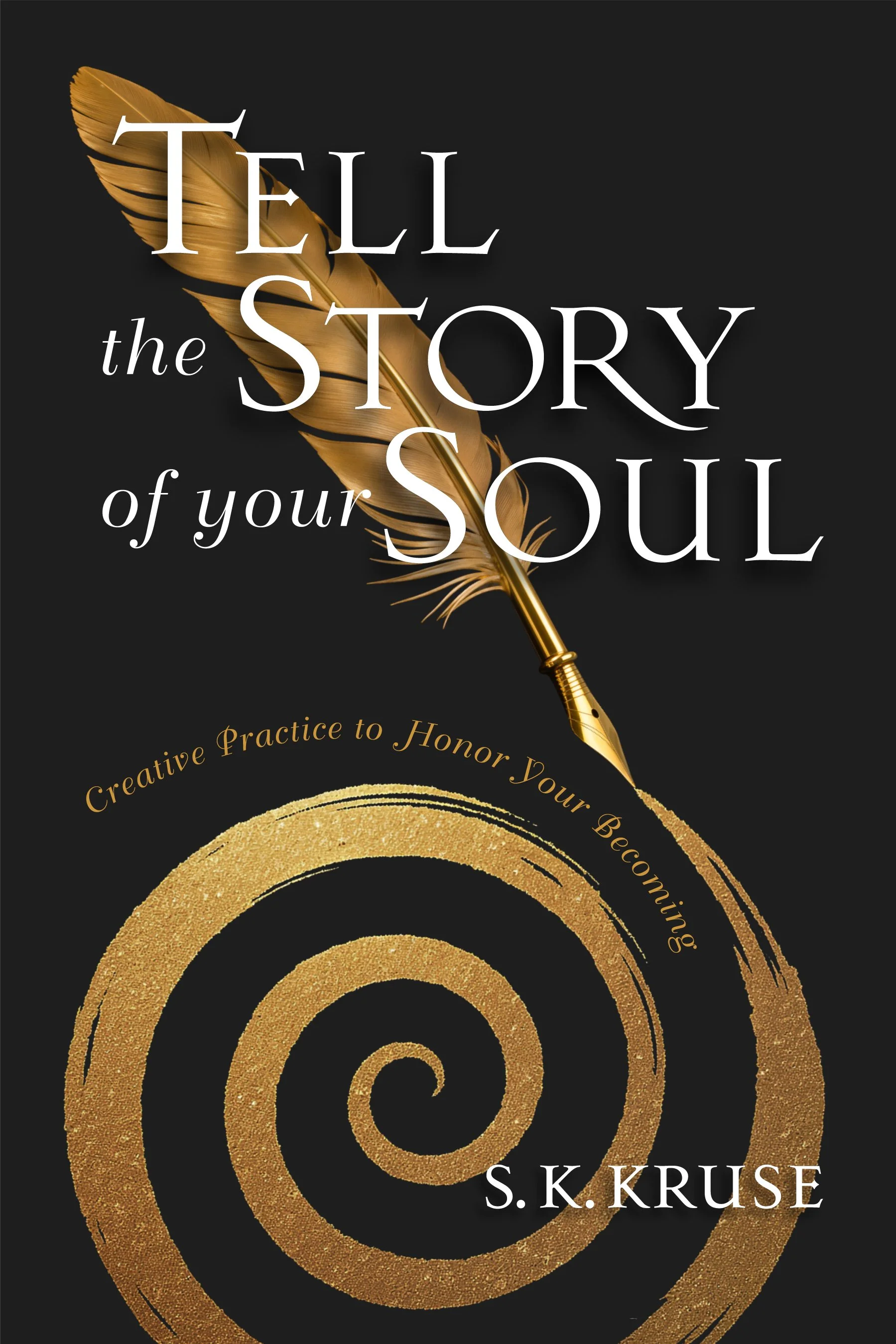
A telography is the telling of that deeper journey, and Tell the Story of Your Soul will help you create your own.
Through Soul Discovery sessions, you’ll delve into the liminal passages of your life, reflecting not only on what happened, but on what it meant for your becoming.
Through Story Crafting sessions, you’ll shape those turning points into a soul-journey narrative using words, images, music, or whatever form feels true to you. You will tell your story for yourself first, so that you can tell it in freedom and truth. Whether you ever share it with anyone else is entirely up to you.
inality
Your Story Told Through its Thresholds
Over a century ago, Arnold van Gennep studied the rites of passage by which human have marked the “crossings” of their lives and gave us language for it. He called it the liminal. Decades later, Victor Turner expanded the application of Gennep’s insights and gave us another name for it:
The betwixt and between.
Telography expands it further.
As a creative practice to honor our becoming, it draws on the ever growing framework of liminality to help us understand the unfolding of our lives through its most meaningful turns, structured around the turns in each phase:
Pre-liminal — the life before: what you were, what you held, what began to loosen.
Liminal — the threshold itself: the neither-here-nor-there, where the old self has gone and the new one has not yet arrived.
Post-liminal — the return: who crossed over, and what they carried back.
When you trace your life through the inner turns of your journey, it can help you embrace the whole of your journey.
And honor your becoming.
Every soul has a story.
Perhaps it's time to tell yours.
Soul Stories
Throughout History
Here’s a sampling of some of the more famous telographies throughout history.
Click the the entries to learn a little more about each of them.
autobiographical & Biographical Telographies
-
c. 397–400 CE; Christian, late antiquity. Augustine narrates his early life and conversion, reflecting on key themes like sin, desire, memory, time, and Scripture as a way of explaining how he came to faith and how he understands God’s action in a human life.
-
c. 1106. Islam. This is a brilliant account of “epistemological conversion,” tracking the soul’s movement through certainty, doubt, and ultimately Sufi-inflected insight as a rescue from illusion.
-
c 1488; Tibetan Buddhist. This is a dramatic transformation arc—harm to remorse to discipline to awakening—told as an exemplar story meant to form the reader as much as inform them.
-
1562–1565; Catholic Christian. This is a candid interior account of prayer, doubt, mystical experience, and discernment, and it is far more about “states of the soul” than external events.
-
1814; Jewish / Hasidic, early tradition. This is hagiographic rather than self-written, but it still operates as “soul-biography,” built from encounters, wonders, devotion, and a focus on inner purity.
-
1898; Catholic Christian, Discalced Carmelite. A memoir compiled from three manuscripts—childhood and vocation, a retreat text, and reflections from her final year—presenting her “Little Way” through concrete episodes of ordinary life, prayer, and spiritual struggle rather than a traditional plot-driven autobiography.
-
1908; Jewish / Hasidic. The Baal-Shem interpreted through Buber's I-Thou philosophy. Founding legends of Hasidism as a sustained soul-narrative.scription
-
1932; Lakota/Indigenous spirituality, as told to John G. Neihardt. This is vision-centered and shaped by sacred history, so it reads more like “calling and cosmology” than conventional autobiography.
-
1946; Hindu / Kriya Yoga. This is a spiritual-quest narrative organized around teachers and realizations, with the metaphysics of awakening acting as the story’s underlying scaffolding.
-
Published 1948; Catholic Christian, 20th c. This is a modern conversion memoir that is really about longing and restlessness, and about the slow reorientation of the self toward a different center of gravity.
-
1966; Tibetan Buddhist. This is part life story and part lineage-and-training narrative, where identity is forged through practice, vows, and disciplined spiritual formation.
-
2006; memoir-based spiritual journey. A travel memoir of personal reset—pleasure in Italy, spiritual practice in India, and integration in Bali—framed as a search for healing and meaning rather than a formal conversion.
allegorical, fictionalized, or semi-autobiographical Telographies
-
c. 1177; A classic Sufi allegory: a collective pilgrimage that becomes a staged path of ego-loss and awakening.
-
1308–1321; Catholic Christian, medieval. The archetypal Western soul-journey: descent into hell, ascent through purgatory, and arrival at the beatific vision.
-
1678—1684; Protestant Christian. This is a Christian allegory framed as a dream-journey in which the main character (“Christian”) travels from the “City of Destruction” to the “Celestial City,” meeting personified forces like fear, doubt, temptation, and spiritual support along the way; it’s less about Bunyan’s own life and more about mapping the stages of conversion and perseverance in a way readers can recognize in themselves.
-
1884; Eastern Orthodox devotional journey. (Attributed to Archimandrite Michael Kozlov.) A wandering narrator practices the Jesus Prayer “without ceasing,” and the travel structure mainly serves as a practical, experiential guide to interior prayer. This one could be an account of an actual person’s life, but we don’t know.
-
1922; philosophical spiritual quest. A fictional seeker’s life becomes a sequence of experiments—asceticism, pleasure, despair, insight—aimed at self-knowledge and a changed relationship to suffering and desire.
-
1927; Darker and more existential than Siddhartha, but still a “seekers’ book” about crisis, fragmentation of self, and a push toward integration. There are three more works of Hesse that could go on this list!
-
1943; philosophical fable. A deceptively simple travel/encounter story that uses symbolism to examine love, responsibility, loss, and what a meaningful life pays attention to.
-
1970; A compact allegorical fable about discipline, transcendence, and self-realization—lighter and more parable-like than Hesse.
-
1974; philosophical “values quest,” autobiographical novel. Not “fully fictional,” but a hybrid built around a real cross-country motorcycle trip Pirsig took with his son, shaped with novelistic craft and a narrator/persona rather than a strictly documentary memoir approach.
-
1988; modern spiritual allegory / “wisdom tale”. Like Bunyan’s The Pilgrim’s Progress, this is a symbolic journey narrative where the outer plot is really a map of inner formation—fear, calling, trust, surrender, and perseverance. Unlike classic telographies (Augustine, Teresa, al-Ghazālī), it isn’t a lived spiritual autobiography rooted in a specific tradition; it’s a universalized parable meant to be applied to the reader’s life rather than to document the author’s.
-
2026; allegorical telography. A literary novel of interior pilgrimage in which the protagonist repeatedly enters the Hall of Beginnings and Ends, where she must choose between the crucible of transformation or the slow decay of refusing to change.