We Cannot Live in a World Interpreted for Us by Others
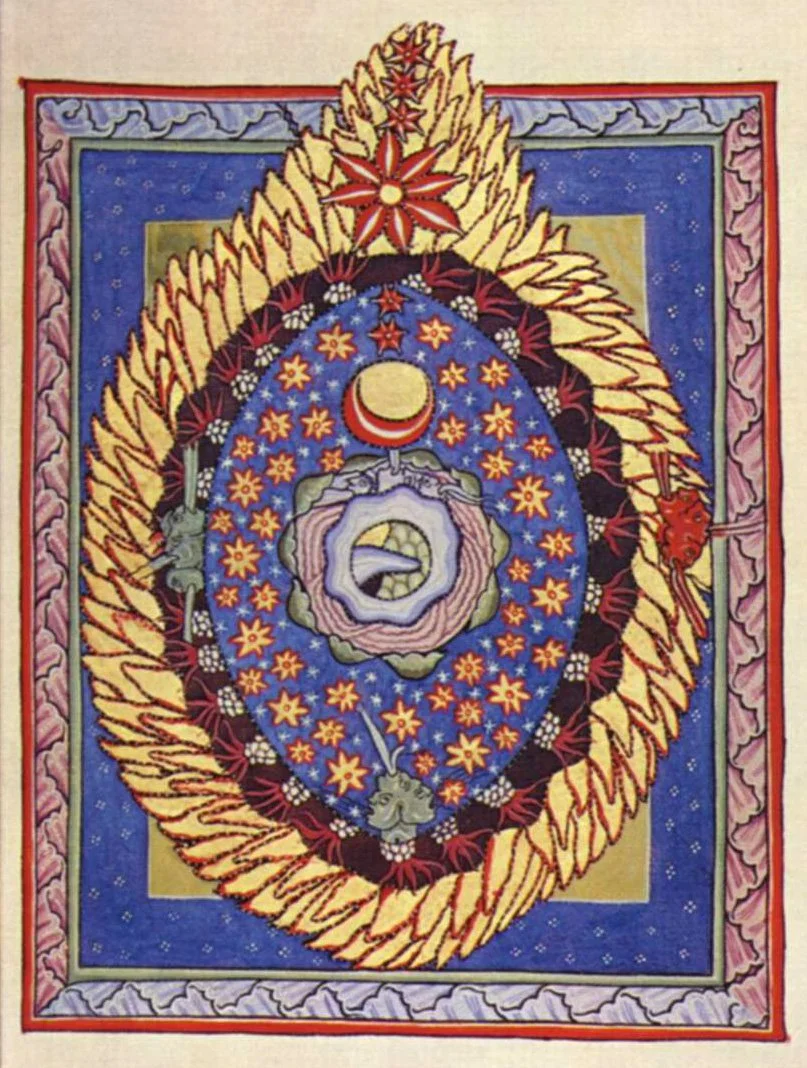
Illumination accompanying the third vision of Part I of Scivias. Photo By Meister des Hildegardis-Codex - The Yorck Project (2002) 10.000 Meisterwerke der Malerei (DVD-ROM), distributed by DIRECTMEDIA Publishing GmbH. ISBN: 3936122202., Public Domain, https://commons.wikimedia.org
This week’s libation comes to us from Eibingen Abbey, where resided Hildegard of Bingen — abbess, anchorite, composer, mystic, artist, natural scientist, polymath, and Benedictine badass.
And from a writer who distilled a message for us from her a millennium later.
“We cannot live in a world interpreted for us by others.
An interpreted world is not a hope.
Part of the terror is to take back our own listening.
To use our own voice.
To see our own light.”
About a decade ago, I discovered this quote.
It’s widely attributed to Hildegard of Bingen—but it’s actually a paraphrase from an article by Elaine Bellezza about Hildegard (Gnosis magazine, vol 21, 1991).
It was a life raft for me.
If you’ve taken your religion seriously but felt your mind and conscience usurped by a religious authority, perhaps you’ll understand.
Taking back our own listening is a long, hard journey.
It’s much easier to have someone tell us what to think.
Tell us what to do.
There’s a sense of safety and relief in surrendering that part of ourselves.
Especially if we’re promised salvation.
Especially if we’re told doing otherwise is a sin.
Self-actualization is difficult no matter what our path, but I suspect it’s one of the greatest challenges for a conscientious religious person. Even more so if we’re part of a religious group that insulates itself from the world—the greater the insulation, the more difficult the journey.
At some point, though, if our inner light is at odds with our religious authorities, we have to make the hard decision about which we’re going to listen to. We have to choose between living in bad faith or living by our inner light.
Jesus, of course, had to make this choice.
And we all know how that ended for him.
Hildegard, like many other great souls who’ve gone before us, had her own run-ins with religious authorities, but she stayed true to what she knew to be right—and paid the price for it.
One of these days, I’d love to write a film script about this extraordinary woman. But for now, I’ll be content with sharing a little bit about her here. Perhaps you’ll find her as inspiring as I do
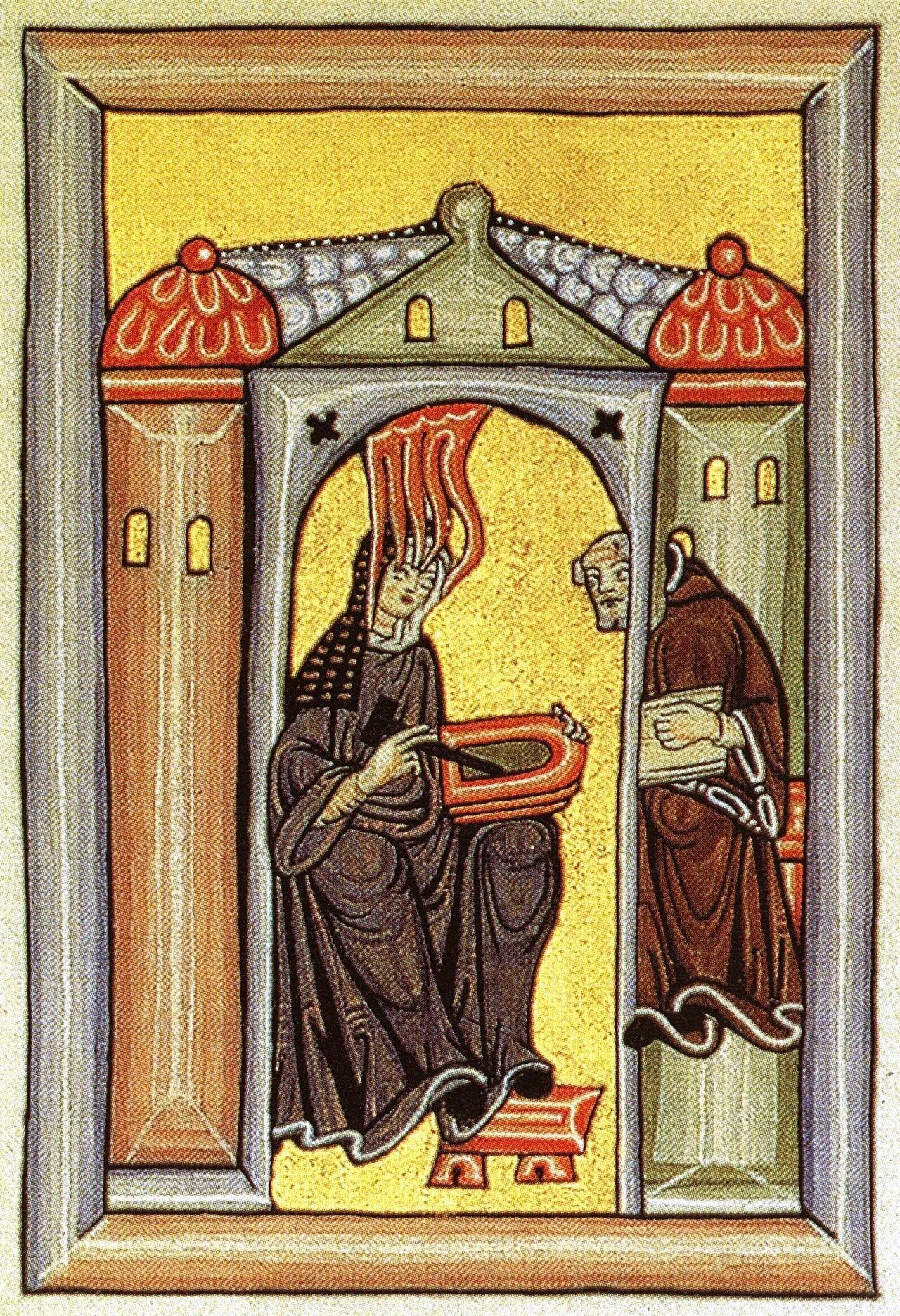
Self Portrait. Hildegard von Bingen receives a divine inspiration and passses it on to her scribe. Public Domain.
Hildegard of Bingen (1098–1179)
Hildegard of Bingen was a German Benedictine abbess, visionary mystic, composer, poet, healer, naturalist, and theologian — one of the most remarkably multifaceted figures of the medieval world, and arguably the most influential woman of the 12th century. She was canonized by Pope Benedict XVI in 2012, and declared a Doctor of the Church — only the fourth woman ever to receive that title.
Early Life
Hildegard was born in Bermersheim, Germany, the tenth child of a noble family and was offered to the Church as a tithe. This was a common practice called oblation, though to our modern sensibilities it sounds like abdication. She was placed in the care of the anchoress Jutta of Sponheim, with whom she lived enclosed at the Benedictine monastery of Disibodenberg. After Jutta’s death in 1136, Hildegard was elected magistra of a growing community of women there.
In 1141, at the age of 42, Hildegard received what she described as a divine command to write and speak her visions publicly. This required enormous courage for a woman of her era, not to mention the official approval from Bernard of Clairvaux and Pope Eugenius III. The ecclesiastical sanction she received from them gave her a platform almost unheard of for medieval women.
At the age of 52 (Shout-out to every middle-aged woman embarking on a new adventure!) navigated the monied politics of the day to found her own independent monastery at Rupertsberg (c. 1150) and a second one at Eibingen (1165), securing genuine institutional authority over her own community.
Visionary and Theologian
While I’m partial to Hildegard’s angelic music, her visionary writings are her most celebrated legacy for many. Her first and greatest work, Scivias (Know the Ways), was a decade in the making and recorded 26 visions concerning the cosmos, the fall, redemption, and the Church. It was followed by Liber Vitae Meritorum (the Book of Life’s Merits) and Liber Divinorum Operum (the Book of Divine Works).
Her theology was richly cosmological, centered on the concept of viriditas — the greening power or vitality — a divine life-force she saw flowing through all of creation, the body, the soul, and the Church. She was deeply incarnational and sensory in her spirituality, which was, like so many things about her, unusual for her time.
She said her visions were not trances or ecstatic states. That she was fully conscious and awake, through what she called the living light and the reflection of the living light.
The distinction was important to her.
She claimed not prophetic seizure but a kind of illuminated wakefulness. Many scholars today note that her descriptions of shimmering lights, geometric forms, and auras are consistent with the visual phenomena of severe migraines, which she almost certainly suffered throughout her life.
(SIDE NOTE: Some may try to dismiss Hildegard’s visions because of her migraines—as they do Teresa of Avila’s because she may have had temporal lobe epilepsy—but whatever the neuro-situations of these women—they accomplished incredible things. Theological treatises do not get written, monasteries do not get founded, and music does not get composed by migraines or seizures.)
Illumination accompanying the third vision of Part I of Scivias. Photo By Meister des Hildegardis-Codex - The Yorck Project (2002) 10.000 Meisterwerke der Malerei (DVD-ROM), distributed by DIRECTMEDIA Publishing GmbH. ISBN: 3936122202., Public Domain, https://commons.wikimedia.org

Universal Man illumination from Hildegard's Liber Divinorum Operum, I.2. Lucca, MS 1942, early 13th-century copy. Public Domain.
Artist
Hildegard of Bingen stands as one of the most original artists of the medieval world, working in music, poetry, painting, and dramatic composition with a singular and unmistakable voice. She was the guiding creative intelligence behind the luminous manuscripts of her visions, filled with vivid cosmological images, dense with symbolic color and form.
Composer
Hildegard composed an extraordinary body of sacred music, an accomplishment that, on its own, would have secured her a place in history. She wrote over seventy breathtaking chants (which I listen to on the regular) their soaring, wide-ranging lines pushing far beyond the measured restraint of Gregorian convention. They are collected in the Symphonia armonie celestium revelationum, or the Symphony of the Harmony of Celestial Revelations. She also wrote Ordo Virtutum, a musical morality play dramatizing the battle for the human soul, which is one of the earliest works of music theater with a named composer!
Her music has experienced a revival and is now widely performed and recorded.
Shout out to Sequentia for bringing Hildegard’s music to the modern world!
Natural Philosopher
Hildegard was a serious observer of the natural world. Her two scientific works — Physica and Causae et Curae — catalogued plants, animals, stones, and metals alongside their medicinal properties, drawing on both classical humoral theory and her own empirical knowledge. Her approach to the body was holistic, attentive to diet, environment, and spiritual wellbeing together. These texts remain fascinating documents of 12th-century natural philosophy.
Preacher
Highly unusual for a woman of her era, Hildegard undertook four preaching tours throughout Germany late in her life, addressing clergy and laity directly — an almost unimaginable act of public authority. She maintained an enormous correspondence with popes, emperors, abbots, abbesses, and ordinary people, frequently delivering blunt prophetic rebukes to those in power.
Though it would come back to bite her, as so often such things do when one speaks truth to power.
Conscientious Objector
Late in her life, Hildegard made a decision that brought the full weight of institutional authority down on her community. She permitted the burial of a nobleman in her monastery's cemetery — a man the Church had declared excommunicated. When the Church ordered her to exhume the body, she refused, arguing that he had died reconciled to God, having received last rites, and that to disturb his grave would be a desecration.
The Church's response was severe.
Her monastery was placed under interdict, and her community of nuns was forbidden from singing the Divine Office — a punishment striking at the heart of Benedictine life and, for Hildegard, the deepest wound imaginable.
She wrote a fierce and beautiful letter to the Church authorities defending sacred music as essential to the soul's communion with God, arguing that to silence it was to silence heaven itself.
Finally, just a few months before her death, the interdict was lifted.
She’d held her ground for nearly a year.
Pray for us, Hildegard. May we all have your wisdom and courage.
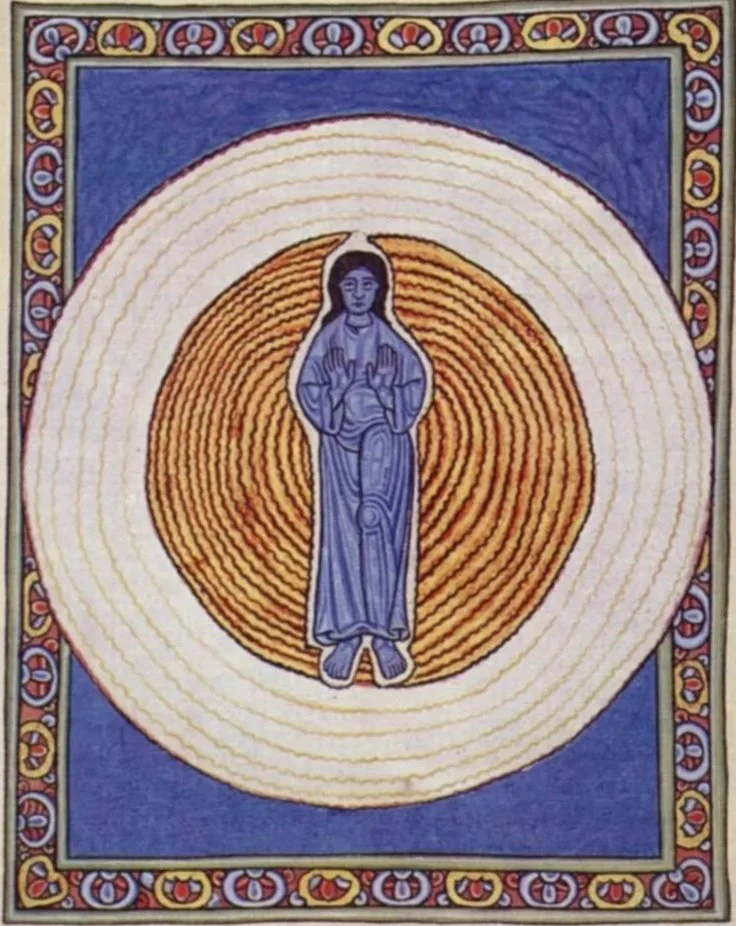
Illumination accompanying the second vision of Part II. Photo by Meister des Hildegardis-Codex - The Yorck Project (2002) 10.000 Meisterwerke der Malerei (DVD-ROM), distributed by DIRECTMEDIA Publishing GmbH. ISBN: 3936122202. Public Domain, https://commons.wikimedia.org/w/index.php?curid=155274
“I am the fiery life of the essence of God; I am the flame above the beauty in the fields; I shine in the waters; I burn in the sun, the moon, and the stars. And with the airy wind, I quicken all things vitally by an unseen, all-sustaining life. ”
Further Libations
Live with a Full Moon in Each Eye — "Admit Something," the best poem I have read on love — and the question of who actually wrote it.
The World Is a Vale of Soul-Making — Keats, the Romantics, and the Existentialists in one Venn diagram.
How to Navigate a Liminal State — practices for the interior work, for when muscling through stops working.
Tales From the Liminal now available as an audiobook on all your favorite platforms!
